

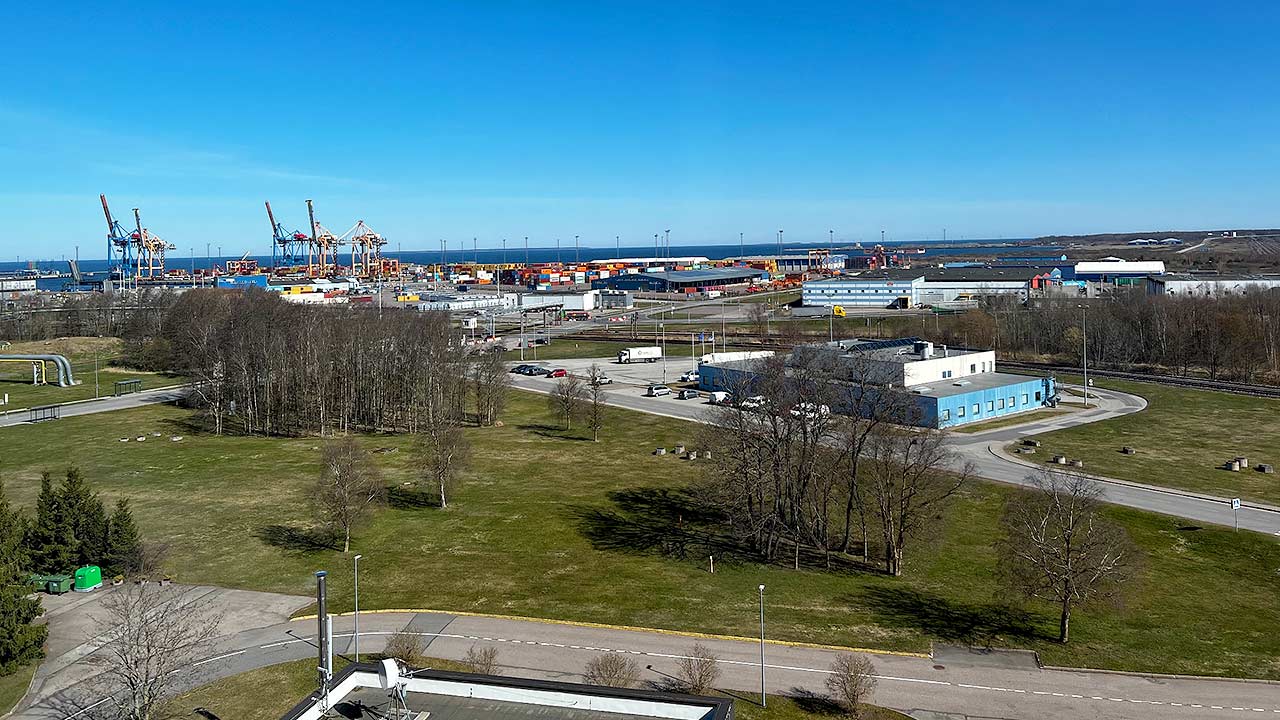
On April 20, 2026, in Tallinn, Oleksandr Pietushkov, Director of International Cooperation and Development of NSPS, held a working meeting with Stig Rogenbaum, Business Development Sales Manager at Port of Tallinn, focused on industrial parks, port infrastructure, multimodal logistics and the prospects of Rail Baltica for Estonia and the wider Baltic region
Port of Tallinn was presented as a multi-dimensional infrastructure ecosystem structured around four directions: passenger services (10+ million passengers and ~5,500 ship calls per year), cargo logistics (15+ million tonnes and ~1,600 cargo calls), shipping and real estate development.
A central focus was the Muuga freight terminal — the only Rail Baltica cargo terminal directly connected to a seaport (~€80 million budget, construction 2027–2030, handling both 1,435 mm and 1,520 mm gauge rail).
Rail Baltica in Estonia covers 213 km of main line, international passenger terminals, 12 regional stations, 100+ rail crossings and around 33 eco-ducts; projected freight volume reaches 9.1 million tonnes by 2045.
Key discussion topics:
- Port of Tallinn as a four-pillar platform: passengers, cargo, shipping, real estate development
- Muuga freight terminal — the only Rail Baltica terminal with direct sea access (~€80M, 2027–2030)
- Dual-gauge compatibility (1,435 mm & 1,520 mm) for seamless Baltic — Central Europe logistics chains
- Rail Baltica in Estonia: 213 km of line, 12 regional stations, 100+ crossings, ~33 eco-ducts
- Projected freight up to 9.1 million tonnes by 2045; Estonia’s share 3–4 million tonnes/year
- Industrial parks Muuga (76 ha), Paldiski South (39 ha) and Saaremaa (10 ha) as a comprehensive development model
Takeaways for Ukraine:
Reference model for Ukraine
- Combining a port, railway, dry ports, industrial parks and commercial real estate into a unified system — a valuable benchmark for planning future logistics hubs and border territories
Integration with EU corridors
- Rail Baltica lessons for integrating Ukraine into European transport corridors during reconstruction
Involving designers early
- Reaffirmed the importance of involving architects, engineers and transport experts in large-scale infrastructure projects from the very start of planning
